

Hang the centre of your artwork at 57 to 60 inches (145 to 152 cm) from the floor. That’s the standard eye-level height galleries have used for decades, and it works for most walls in most rooms. The one exception that matters: if the piece hangs above a sofa, console, or bed, let the furniture set the height instead, leaving a 6 to 8 inch (15 to 20 cm) gap above it.
TL;DR:
- The correct hook placement must account for the artwork’s center height, its total height, and the taut wire drop, not just a fixed measurement from the floor.
- When hanging art above furniture, leave a gap of 4 to 8 inches between the frame and the top of the furniture to maintain visual harmony.
- For gallery or clustered arrangements, treat the collection as a single unit, using paper templates and consistent spacing to ensure balanced composition.
- Avoid common mistakes by measuring to the artwork’s center, subtracting wire drop, and double-checking the placement from seated and standing viewpoints.
- Wall anchors and mounting hardware should match the weight of the artwork, with use of studs for heavy pieces and templates for precise positioning.
Table of Contents
- What is the art hanging height rule, and how do you measure it?
- How high should art hang above a sofa or console?
- How do you hang a gallery wall or grouped arrangement?
- What about stairwells, high ceilings and seated rooms?
- What are the most common art hanging mistakes?
- What hardware and tools do you need to hang art safely?
- Frametheworld’s practical templates and Lennard’s tips
- Why the 57-inch rule gets misapplied more than it gets ignored
- Sources
- FAQ
What is the art hanging height rule, and how do you measure it?
The 57 to 60 inch centre rule comes from museums and galleries, where curators hang works so the midpoint sits at average standing eye level. It’s a convention, not a law of physics, but it is a remarkably good starting point because it accounts for how people actually stand and look at things in a room, rather than how the frame looks from across the shop floor.
Getting from that abstract number to an actual nail in the wall takes a bit of arithmetic, and this is where most people go wrong. You’re not marking 57 inches and banging in a hook. You’re finding where the hook needs to sit so the centre of the art ends up at 57 inches, and those two points are rarely the same.
Here’s the process:
- Measure the height of your framed artwork, top to bottom.
- Divide that figure in half to find the artwork’s centre point.
- Measure the “drop”: the distance from the top of the frame down to the taut wire or hanging bracket when pulled tight.
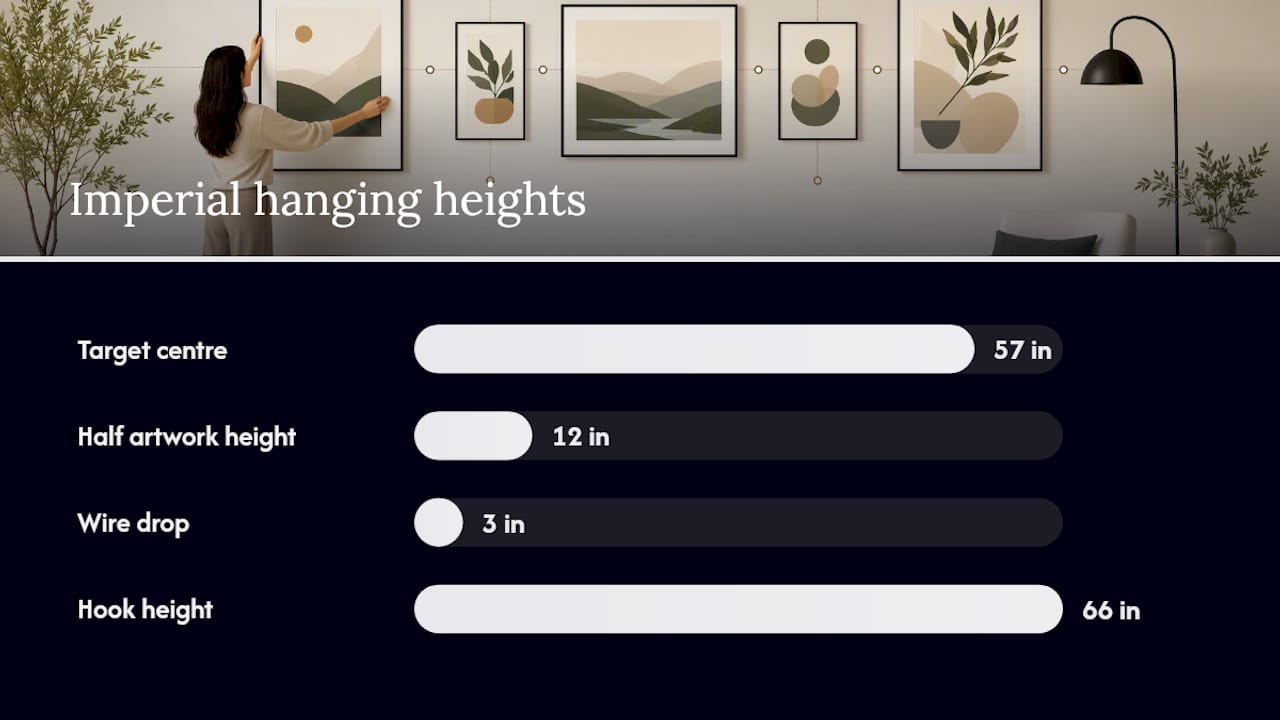
- Take your target height (57 inches, or 145 cm), add half the artwork’s height, then subtract the drop. That final number is where the hook goes.
Pro Tip: Pull the wire taut with your fingers before measuring the drop. A slack wire will throw your hook placement off by an inch or more once the frame settles under its own weight.
Worked example in imperial: a 24 inch tall frame, hung at a 57 inch target centre, with a 3 inch wire drop. Half of 24 is 12, so 57 + 12 = 69, then 69 minus 3 gives a hook height of 66 inches.
In metric: a 600mm frame at a 1,450mm target centre, with a 75mm drop. Half of 600 is 300, so 1,450 + 300 = 1,750mm, minus 75mm gives a hook height of 1,675mm.
Mark your hook position lightly in pencil before drilling, and get a second person to hold the frame in place first. Stepping back to check it against eye level, rather than trusting the tape measure alone, catches mistakes before they become holes in the plaster.
How high should art hang above a sofa or console?
The 57 inch rule assumes an empty wall. Put a sofa, sideboard or bed underneath the art and the furniture becomes the more important reference point, because a piece that floats too high above a low sofa looks disconnected no matter how correct the “eye level” maths is.
- Above a sofa: leave 6 to 8 inches (15 to 20 cm) between the top of the cushions and the bottom of the frame.
- Above a console or side table: a slightly tighter gap works, 4 to 8 inches (10 to 20 cm), since consoles sit lower and closer to the eye than a sofa back.
- Above a bed or headboard: 4 to 8 inches (10 to 20 cm) is standard, though very tall upholstered headboards can take 8 to 12 inches without the art looking marooned.
- Width: the artwork, or the total spread of a grouped arrangement, should span roughly two-thirds to three-quarters of the furniture’s width beneath it.
So which rule wins, eye level or furniture gap? If there’s furniture directly beneath the art and it’s the visual anchor of that wall, follow the furniture. If the wall is genuinely open, default to 57 inches. A quick way to check you’ve got it right: stand at the doorway and see whether the art and furniture read as one grouping or two separate things stacked awkwardly on top of each other.
How do you hang a gallery wall or grouped arrangement?
Treat a cluster of frames as a single large artwork, not several small ones. That single shift in thinking solves most of the layout headaches people run into.
- Lay every frame out on the floor first, arranged exactly as you plan to hang them, and step back to check the overall shape reads as one balanced composition.
- Find the centre point of the entire arrangement, treating its outer edges as if they were the edges of one big frame.
- Position that overall centre at 57 inches, or follow the furniture-anchor rule if the grouping sits above a sofa or console.
- Keep spacing between individual frames consistent, around 2 to 3 inches (5 to 8 cm), so the eye reads gaps as intentional rhythm rather than clutter.
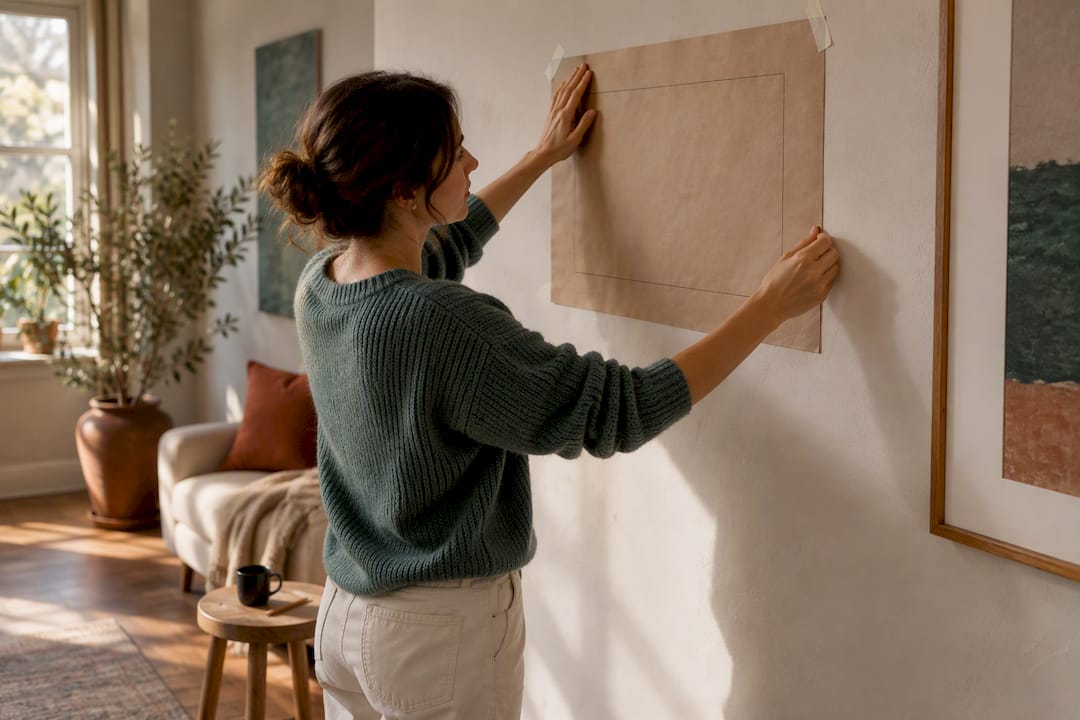
- Cut paper templates matching each frame’s size, tape them to the wall in your planned layout, and adjust before you drill a single hole.
Stair runs need their own version of this logic: measure 57 inches up from the step directly beneath each frame, rather than from the floor at the bottom, so the sequence climbs the wall on the same diagonal as the staircase itself.
What about stairwells, high ceilings and seated rooms?
The 57 inch figure is a starting point for a standing adult in an ordinary room. Change the room and the number should move with it.
- Stairwells: step-by-step, measuring 57 inches from each tread as you go, keeps the art parallel to the stair line instead of drifting off at an angle.
- High ceilings: resist the urge to push the centre higher just because there’s wall to fill. Choose a larger single piece or a stacked grouping instead. A very tall wall calls for bigger art, not a higher hanging point, because viewers still need to see the focal point without tipping their head back.
- Seated rooms: dining rooms and lounges where people spend most of their time sitting benefit from a slightly lower centre, around 54 to 58 inches (140 to 147 cm), matching where a seated person’s eyes actually land.
- Oversized single pieces: if one artwork dominates a wall, keep its focal area (not necessarily its geometric centre) at eye level, and consider whether scaling the piece up solves the space problem better than shifting it higher.
Pro Tip: In an open-plan room used both standing and seated, split the difference and hang at 56 inches. It reads correctly from either position without looking obviously compromised for one or the other.
What are the most common art hanging mistakes?
The single most frequent error is measuring to the top of the frame instead of its centre, which throws every calculation that follows off by half the artwork’s height. The second most common mistake sits right alongside it: forgetting to subtract the wire drop, so the hook ends up too high and the finished piece hangs several inches above where it was meant to.
- Measuring to the frame’s top edge rather than its vertical centre.
- Skipping the wire or bracket drop subtraction entirely.
- Hanging a small piece above a wide sofa or sideboard, breaking the two-thirds width guideline.
- Skipping a paper mock-up and going straight to the drill.
- Never checking the result from a seated position, only from standing across the room.
| Mistake | Fix |
|---|---|
| Measuring to frame top | Always measure to the artwork’s vertical centre |
| Ignoring wire drop | Subtract the taut wire distance from your target hook height |
| Undersized art over furniture | Match roughly two-thirds to three-quarters of furniture width |
| No test layout | Use paper templates or painter’s tape before drilling |
What hardware and tools do you need to hang art safely?
A lightweight print on a standard picture hook is a five-minute job. A large canvas or anything hung above a bed is a different proposition, and the fixing needs to match the weight, not just the wall.
- Use a simple picture hook for lightweight prints on plasterboard, but move to wall plugs or a rated anchor once a frame gets heavy or oversized.
- Find a stud with a stud finder and mount into it wherever possible for anything substantial, especially pieces hanging above a bed or seating area.
- Keep a tape measure, spirit level, pencil, paper for templates and a stud finder together as your basic hanging kit.
- Test the wire’s tightness and the hook’s grip before letting go of a heavy frame, particularly on overhead or above-bed placements where a fall matters more.
Frametheworld’s practical templates and Lennard’s tips
Getting the maths right on paper is one thing. Committing to it with a drill in hand is another, which is why paper templates matter more than most guides admit. Cutting a template to the exact size of your frame, taping it up, and living with it for a day before drilling catches problems no calculation will.
Frametheworld’s design team has observed common errors in art placement across projects: art hung too high, pieces sized too small for the wall, and gallery walls planned frame-by-frame instead of as one composition.
For related sizing and layout questions, see guidance on filling a high wall and choosing the right art size for your room.
- Cut a paper template first, always.
- Treat gallery clusters as one shape, not several.
- Measure to centre, never to frame top.
- Recheck from a seated viewpoint before drilling.
If you’re sizing a new piece rather than rehanging an old one, Frametheworld’s hand-painted collection can be made to the exact dimensions your wall and furniture call for, including bespoke commissions for awkward or oversized spaces.
Why the 57-inch rule gets misapplied more than it gets ignored
Most people who get art hanging height wrong aren’t ignoring the 57 inch rule. They know it exists, they’ve heard it quoted in a magazine or a shop, and they still hang things too high. The failure is almost always in the arithmetic, not the intention. Skipping the wire-drop subtraction is the single most avoidable mistake in this entire guide, and it accounts for more crooked, too-high artwork than bad taste ever will.
The conventional advice oversells the number itself and undersells the process. A 57 inch centre is worthless if you measure to the top of the frame instead of the middle, or forget that a wire hangs an inch below the hook once weight is on it. What actually matters is the sequence: measure the art, halve it, account for the drop, then mark the wall. Do that correctly and the exact number, 56 or 58 or 60, matters far less than people assume.
If there’s one thing to prioritise, it’s furniture. A technically perfect 57 inch hang above a sofa still looks wrong if it ignores the piece sitting beneath it. Trust the room over the ruler when the two disagree.
— Lennard
Sources
- Art Hanging Guide: Heights, Spacing & Gallery Walls | The Hanging Calculator
- How High to Hang Art: The 57-Inch Rule and Every Exception
- How to Hang Art — Height Rules, Hardware & Gallery Walls
- How to hang a picture (practitioner guidance) | Architectural Digest
FAQ
What is the 2/3 rule for hanging pictures?
The 2/3 rule refers to width, not height: artwork hung above a sofa, console or bed should span roughly two-thirds to three-quarters of that furniture’s width. A piece narrower than this tends to look undersized and disconnected from the furniture beneath it.
What is the 57 inch rule?
The 57 inch rule states that a piece of art’s vertical centre should sit about 57 to 60 inches (145 to 152 cm) from the floor, matching average standing eye level. It’s a strong default for open wall space, though furniture or seated rooms can shift it slightly.
What is the standard height for hanging art in a museum?
Museums and galleries typically centre artwork at 57 to 60 inches (145 to 152 cm) from the floor, the same convention behind the household rule. Some galleries adjust slightly for a piece’s scale or the room’s ceiling height, but 57 inches remains the benchmark.
What are common picture hanging mistakes?
The two most frequent errors are measuring to the top of the frame instead of its centre, and forgetting to subtract the wire or bracket drop before marking the hook position. Hanging undersized art above wide furniture, and skipping a paper template before drilling, round out the most common problems.
How do you adjust art height for a seated room or dining area?
In rooms where people spend most of their time sitting, lower the centre slightly to around 54 to 58 inches (140 to 147 cm) rather than the standard standing eye level. This keeps the artwork’s focal point aligned with where a seated person’s eyes naturally rest.


Laat een reactie achter
Deze site wordt beschermd door hCaptcha en het privacybeleid en de servicevoorwaarden van hCaptcha zijn van toepassing.