

Concealed multi‑point locking systems and T‑screw anti‑theft kits are the two most theft‑resistant ways to hang art, full stop. Systems like the Ryman hanger (high security set), SpringLOCK and Chassitech’s Lock 8 keep fixings hidden and removable only with a matching key, while generic T‑screw kits do the same job more cheaply on ordinary frames. For anything heavy, glazed, or hung in a public venue, get a professional to fit it.
TL;DR:
- Concealed multi-point locking systems like the Ryman high security set and Chassitech Lock 8 offer the highest theft resistance, with load capacities up to 150 kg per point.
- Installers should ensure wall substrates support heavy art, as solid concrete or timber supports significantly higher weights than plasterboard or masonry.
- For public venues with many frames, T-screw security kits and SpringLOCK brackets provide low-cost, discreet, and scalable solutions, but require professional installation for large quantities.
- When choosing hardware, consider concealment level, ease of maintenance, and the need for independent key management, especially in high-risk environments.
- Professional installation becomes essential for large, glazed, or historically significant works to prevent damage, especially in high-traffic or liability-sensitive settings.
Table of Contents
- What are the best security hangers for art?
- How do you choose the right security hanger for your artwork?
- How do you fit a security hanger without damaging the wall?
- When should you hand the job to a professional?
- The trade‑off nobody puts on the box
- Prefer a supplier who handles the art and the advice?
- Where these figures come from
- Sources
- FAQ
What are the best security hangers for art?
Every system on the market solves the same problem differently: how do you stop a frame lifting off the wall without a tool nobody else has? Some rely on a locking screw buried behind the frame. Others use a keyed spring keeper. A few just make the fixing awkward enough that a casual thief gives up.
The table below lines up the main contenders on the things that actually matter when you’re specifying hardware: how secure the lock is, how much weight it takes per point, whether it disappears behind the frame, and what tool you need to get it off again.
| System | Security level / locking type | Max load (per point) | Concealment | Removal tool | Best for | Price band |
|---|---|---|---|---|---|---|
| Ryman hanger (high security set) | Keyed spring keeper, three security tiers | Up to 150 kg on extended variants | Fully concealed, flush finish | Numbered security key | Museums, high‑risk public displays | High |
| Chassitech Lock (Lock 8) | Adjustable locking plate with bottom locking screw | High load rating, four‑lock configurations recommended | Flush, discreet | Special screwdriver | Galleries and collectors wanting adjustable discretion | Mid to high |
| Varihook (Chassitech) | Solid‑brass locking hook, micrometric adjustment | Up to 50 kg in concrete or wood, less in masonry or plasterboard | Discreet, low‑profile | Special screwdriver | Homes and offices wanting one strong, adjustable point | Mid |
| Artiteq H100 secured hook | Self‑locking hook with safety clip, wire‑mounted | Up to 20 kg per hook | Semi‑concealed on wire/track systems | Safety clip release (tool‑light) | Mid‑weight framed works on perlon or steel wire | Low to mid |
| T‑screw security kit (generic) | T‑head screw locked into wall bracket | Load capacity depends on number of fixings and wall type | Low visibility, screw head sits flush | Security wrench | Hotels, restaurants, venues with many frames | Low |
| SpringLOCK | Spring‑loaded anti‑theft bracket | Bracket‑dependent, scales with fixing points | Flush bracket, hidden spring mechanism | Proprietary key/tool | Residential and small commercial displays | Low to mid |
The Ryman hanger earns its museum reputation because it’s genuinely modular. You pick the security tier to match the risk, and the highest tier won’t budge without its own numbered key. That’s brilliant for a public gallery. For simple home displays, a lower tier may suffice.
Chassitech’s Lock 8 and Varihook cover two different jobs from the same brand. Lock 8 is built around four‑lock configurations, which Chassitech positions as the strongest deterrent against forced removal. Varihook is the simpler, single‑point cousin, better suited to a home office or a single statement piece than a full gallery wall.
The Artiteq H100 is the odd one out here, designed for wire and track systems rather than direct wall fixing. It’s the right call for rental galleries or offices that rehang shows often, since the wire system lets you reposition without redrilling.
T‑screw kits and SpringLOCK brackets are the workhorses of hotels and restaurants: cheap enough to fit on every frame in a corridor, discreet enough that guests never notice them.
- Any system with a numbered or proprietary key needs a register. Note the key number against the room or wall it belongs to, and keep a spare with facilities management, not in a drawer near the artwork.
- If you’re fitting more than a handful of frames, buy two spare keys per system now. Reordering a lost key from a manufacturer can take weeks.
How do you choose the right security hanger for your artwork?
Start with the wall, not the frame. A hanger rated to 50 kg means nothing if it’s screwed into plasterboard with a standard wall plug.
- Weigh the piece, glazed and framed. Glass and acrylic add real weight, and heavily glazed works both need more secure fixing and attract more attention from thieves because of the value they signal, according to guidance on gallery wall lighting.
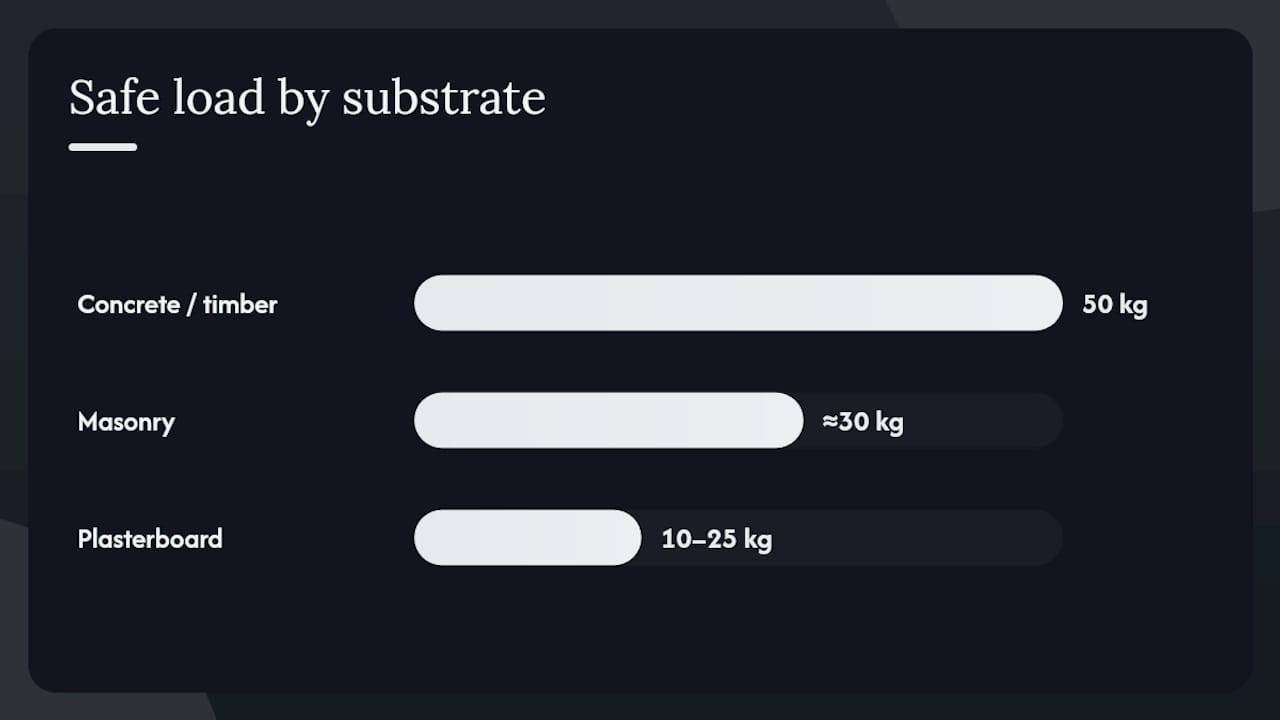
- Identify the substrate. Solid concrete or timber studs can support Varihook’s upper range of 50 kg; masonry drops that to roughly 30 kg, and plasterboard needs specialist plugs or multiple fixing points to hit even 10 to 25 kg safely.
- Decide how much concealment you need. Concealed multi‑point locks like Lock 8 disappear entirely behind the frame, which is ideal for public spaces, but they also mean nobody can casually check or adjust the hang without the key. T‑screw kits are less invisible but far easier to service.
- Ask suppliers the awkward questions. Do they sell replacement keys individually, and how fast? Is the bracket compatible with your frame’s existing rebate or D‑ring? Has the load rating been independently tested, or is it a manufacturer estimate?
- Budget for installation, not just hardware. A single T‑screw kit costs little, but fitting forty of them across a hotel corridor, correctly anchored into mixed substrates, is a day’s skilled labour, not an afternoon DIY job.
Pro Tip: Never assume one hanger’s advertised load rating applies to your wall. Manufacturers test in ideal substrates, so a 50 kg‑rated Varihook can drop to a fraction of that in old plaster. When in doubt, add a second fixing point rather than trust the top‑end figure.
Concealed locks win on theft resistance and finish; T‑screw kits win on cost and speed of maintenance. For a single valuable piece in a private home, a locking plate is worth the extra spend. For dozens of frames in a public venue, a well‑fitted T‑screw system usually makes more practical sense, backed by a professional installation.
How do you fit a security hanger without damaging the wall?
Measure the frame’s fixing points first, then mark the wall with a spirit level rather than eyeballing it. Drill according to the wall plug manufacturer’s bit size, not the screw size, and always fix into a stud or masonry where possible rather than plasterboard alone.
- For T‑screw kits and locking plates: mark, drill, insert the correct plug, fix the bracket, then lock the frame in and test the key before you let go of the piece.
- Split heavier works across two or four fixing points instead of one; it reduces sway and stops a single point taking the full load.
- Store spare keys away from the artwork, ideally with a facilities or security lead, and note serial numbers against each fitting.
- If a key goes missing, contact the manufacturer immediately. Most keyed systems, like Ryman’s numbered sets, can only be safely removed by drilling out the mechanism otherwise, which risks damaging the frame.
- After fitting, check the piece sits level and give it a gentle test pull. It shouldn’t move.
Renting your space? A rental‑friendly hanging checklist covers options that avoid heavy drilling altogether.
When should you hand the job to a professional?
Frametheworld sells hand‑painted art and bespoke canvases to homeowners, interior designers, and commercial clients, and our framing process guide covers the installation questions we get asked most.
DIY hardware works well for most homes. It’s the wrong call in a few situations:
- Large glazed pieces where weight and breakage risk make a single mistake expensive.
- Conservation‑grade or historically significant works, where fixing choices need to protect the piece as much as deter theft.
- High‑traffic public venues, where liability and consistent standards across dozens of frames matter more than any individual hanger’s spec.
- Bespoke frames with unusual backs, where compatibility with standard brackets isn’t guaranteed. Our framing options guide explains how frame back and glazing choice affects fixing compatibility.
The trade‑off nobody puts on the box
Every security decision here is really a trade‑off between theft resistance, everyday access, and how the wall looks afterwards. Concealed, flush systems beat everything else for deterring theft, but someone has to manage the keys, and losing one turns a five‑minute rehang into a repair job. Multi‑point locks also do something T‑screw kits and single hooks can’t manage as well: they cut the pendulum swing that causes accidental falls, which matters more in a corridor full of visitors than a still living room. Keep a written record of which key opens which frame. You’ll need it sooner than you think.
— Lennard
Prefer a supplier who handles the art and the advice?
If you’d rather not retrofit hardware onto an existing piece, there’s another route: commission the artwork itself from a supplier who already thinks about how it will hang. There are UK platforms offering hand‑painted wall art and bespoke canvases, built by artists rather than mass‑produced, serving both homeowners and trade clients on larger projects. This isn’t a hardware substitute. It’s a different starting point for anyone weighing up a new piece rather than securing one they already own.

Browse the Handpainted masterpieces collection to see what’s available, or explore Abstract and Landscape pieces if you’re planning a specific room or commercial space. Get in touch to discuss sizing, framing, and installation advice for your project.
Where these figures come from
- Newly H100 secured hanging hook — confirms the 20 kg load rating and self‑locking wire mechanism.
- Lock 8 adjustable antitheft hanger — source for four‑lock configuration guidance.
- Ryman Hanger (High Security Set) — confirms security tiers and keyed removal.
- Varihook — source for substrate‑dependent load limits.
- Anti-theft Picture Hanging Kit — confirms T‑screw kit contents and mechanism.
FAQ
What is the most secure way to hang a picture?
A concealed multi‑point locking system, such as Chassitech’s Lock 8 or a Ryman high security set, is the most theft‑resistant option because the fixing hides behind the frame and only opens with a matching key. For lighter pieces, a self‑locking hook like the Artiteq H100 offers a good balance of security and ease of adjustment.
How do hotels hang pictures?
Most hotels use T‑screw security kits or SpringLOCK‑style brackets across large numbers of frames, since they’re inexpensive to scale, discreet once fitted, and only removable with a matching security wrench. This keeps corridors and public rooms secure without needing a different hardware solution for every frame.
What are the strongest picture hanging strips?
Adhesive hanging strips aren’t rated for the same loads as mechanical security hangers and shouldn’t be relied on for valuable or heavy artwork. For anything beyond a light, low‑risk print, a mechanical fixing like a T‑screw kit or a Varihook gives a verifiable load rating instead.
What is the best hardware to hang heavy pictures?
For heavier or glazed works, locking plates like Chassitech’s Lock 8, rated for high loads with four‑lock configurations, or Ryman’s extended high security sets, tested up to 150 kg, are built for the job. The wall substrate matters as much as the hanger. Solid concrete or timber studs support far higher loads than plasterboard.
Can Frametheworld advise on secure framing for a new piece?
Yes. Some art providers work with homeowners and trade clients on bespoke, hand‑painted commissions and publish guidance on framing choices that affect how a finished piece hangs. Current pricing details are usually available on their websites.


Leave a comment
This site is protected by hCaptcha and the hCaptcha Privacy Policy and Terms of Service apply.