

Choose a bespoke, hand-painted commission when a space needs an exact palette, an oversized statement piece, or a piece of art that carries brand narrative. Reach for ready-made art when your timeline or budget is tight. This guide covers indoor artworks only, from home interiors to commercial fit-outs, and there are suppliers working in this space.
TL;DR:
- Bespoke commissions are ideal when exact color matching, oversized statement pieces, or a specific story must be conveyed, as ready-made art cannot meet these needs.
- Precise wall dimensions, lighting conditions, material swatches, and clear approval timelines are essential for avoiding delays and cost creep in bespoke projects.
- Indoor artworks typically last decades with proper UV-filtering varnish, while outdoor pieces require weatherproof materials and more frequent maintenance to withstand environmental stresses.
- Installation methods differ significantly, with indoor art using simple hooks and outdoor art needing corrosion-resistant fixings and structural anchoring for wind and weather.
- Style choices for indoor art include fine detail and subtlety for close viewing, whereas outdoor art benefits from bold, high-contrast designs visible from a distance.
Table of Contents
- Indoor vs outdoor wall art: when does a bespoke commission make sense?
- What should go in a commissioning brief for indoor wall art?
- What materials and finishes last longest indoors?
- How long does a commission take and what should trade clients expect?
- How do indoor and outdoor conditions differ for wall art?
- What materials suit weatherproof outdoor pieces?
- How does installation differ for indoor and outdoor pieces?
- What maintenance does each type of wall art need?
- How should style choices differ between indoor and outdoor art?
- Publisher perspective: how Frametheworld approaches bespoke indoor commissions
- Get a bespoke indoor commission started with Frametheworld
- Sources
- FAQ
Indoor vs outdoor wall art: when does a bespoke commission make sense?
The comparison that matters here isn’t indoor versus outdoor. It’s commission versus off-the-shelf, and it comes down to what the wall actually needs. Ready-made art wins on speed and price. Bespoke work wins when the piece has to do a specific job, matching a colour scheme to the millimetre, filling an oversized run of wall, or telling a story that belongs to the business rather than the market.
Commissioning original artwork gives you control over scale, palette and mood in a way that browsing a gallery never quite does, which is why trade studios lean on commissions specifically for oversized statement pieces and exact colour matching. If a designer has specified a linen sofa, a slab of honed limestone and a particular brass finish, a bespoke piece can be painted to sit inside that exact material story. An off-the-shelf canvas, however good, is a lucky guess at best.
Here’s how the two routes actually differ in practice:
- Uniqueness: a commission is one of one; ready-made art, however limited the edition, isn’t.
- Per-unit cost: bespoke work carries a premium for the artist’s time and the back-and-forth of approvals; ready-made pricing is fixed and known upfront.
- Preview and revision: a good commissioning process includes preview stages and rounds of changes before the piece ships; a ready-made purchase is final the moment you click “buy”.
- Repeatability: if you need the same visual language across twelve hotel rooms or six branch offices, a commissioned series scales consistently in a way that hunting for near-identical prints never does.
- Speed: ready-made wins outright when a project has weeks, not months, to dress a wall.
Residential clients usually commission for a single anchor piece, a stairwell, a dining room feature wall, somewhere the room is genuinely built around the art. Commercial clients commission more often for brand narrative, reception walls, boardrooms, or a coordinated set across multiple sites where consistency of tone matters more than any single image.
What should go in a commissioning brief for indoor wall art?
A weak brief is the single biggest cause of delay and cost creep on a bespoke commission. Structuring the brief early with precise dimensions, lighting information and material references removes almost all the guesswork an artist would otherwise have to fill in themselves. Here’s what to hand over before any brush touches canvas:
- Exact wall dimensions and ceiling height, plus the position of doors, windows, skirting and any obstructions the piece needs to clear.
- Photographs of the wall taken at different times of day, showing how daylight and any lamps fall across the space, and flagging direct sun exposure if there is any.
- Physical material swatches and paint codes, not just a photo on a phone screen, since screens shift colour in ways paper and fabric don’t.
- Reference images for mood and palette, even rough Pinterest-style boards, so the artist understands the emotional register you’re after, not just the hex codes.
- Your preferred support and framing expectations, canvas or panel, gallery wrap or a floater frame, plus any constraints on how it will be hung.
- A realistic timeline with named approval stages, so everyone agrees upfront how many rounds of feedback are built into the schedule.
Pro Tip: Send swatches in a padded envelope rather than a photo. Paint and fabric colour shift under different bulbs, and an artist working from a screen image is guessing at a shade you haven’t actually seen yourself.
What materials and finishes last longest indoors?
Support choice shapes both the finish and how the piece survives decades on a wall. Stretched canvas is the standard for most interiors: light, easy to hang, and forgiving of minor humidity shifts in a normal home or office. Linen takes paint with a finer texture and reads as more premium, but it costs more and needs careful tensioning. Wooden panels give the flattest, most stable surface for fine detail work, though they’re heavier and less forgiving if a wall isn’t quite plumb.
Pigment quality determines whether colours hold or fade. Ask any supplier directly about lightfastness ratings on the pigments used, since this is the detail that separates a piece that looks the same in ten years from one that’s noticeably duller. A protective varnish with UV filtering adds a further layer of insurance against fading near windows, and it makes the surface easier to wipe clean.
Framing and hanging systems suited to interiors include:
- Gallery wrap: the canvas is stretched over the frame’s edges with no visible border, giving a clean, contemporary look.
- Floater frames: the canvas sits slightly recessed within a frame, leaving a shadow gap that reads as more traditional and gives the piece visual weight.
- Invisible fittings: French cleats or security hooks that keep large pieces flush to the wall without visible screws.
Day-to-day maintenance is simple: a soft, dry microfibre cloth for dust, no household cleaning sprays, and keeping the piece out of direct, sustained sun where possible even with UV-filtered varnish in place.
How long does a commission take and what should trade clients expect?
Turnaround depends heavily on scale. A single small painting can be finished in a matter of weeks; a large-scale commission or a coordinated multi-piece set for a commercial site typically runs into months, particularly once approval rounds are factored in. Hand-painted work is inherently slower than printed alternatives, a printer or a wallpaper run beats a brush every time on raw speed and text precision, but nothing printed replicates the texture and one-of-a-kind result of a hand-painted piece.
Most studios build in a defined number of revision rounds, and the fastest way to shorten the process is to give unusually precise reference material upfront rather than relying on the artist to interpret a vague brief through several rounds of feedback. Pricing on larger commissions tends to work on a sliding scale, the cost per square inch generally falls as the overall size increases, so it’s worth requesting a project-specific quote rather than assuming a flat rate.
For trade and commercial briefs, a few extra steps matter:
- Site surveys confirm wall condition, access and any structural constraints before a large piece is even started.
- Insurance and certificates of authenticity should be part of the delivery package for higher-value commissions, and many studios include insured delivery as standard.
- Installation coordination, confirming access, hoisting needs and delivery windows, should be settled before the piece ships, not on the day it arrives.
- An art consultant, framer or specialist installer is worth involving once a piece exceeds what two people can safely hang, or when multiple pieces need to read as one coordinated scheme across a site.
How do indoor and outdoor conditions differ for wall art?
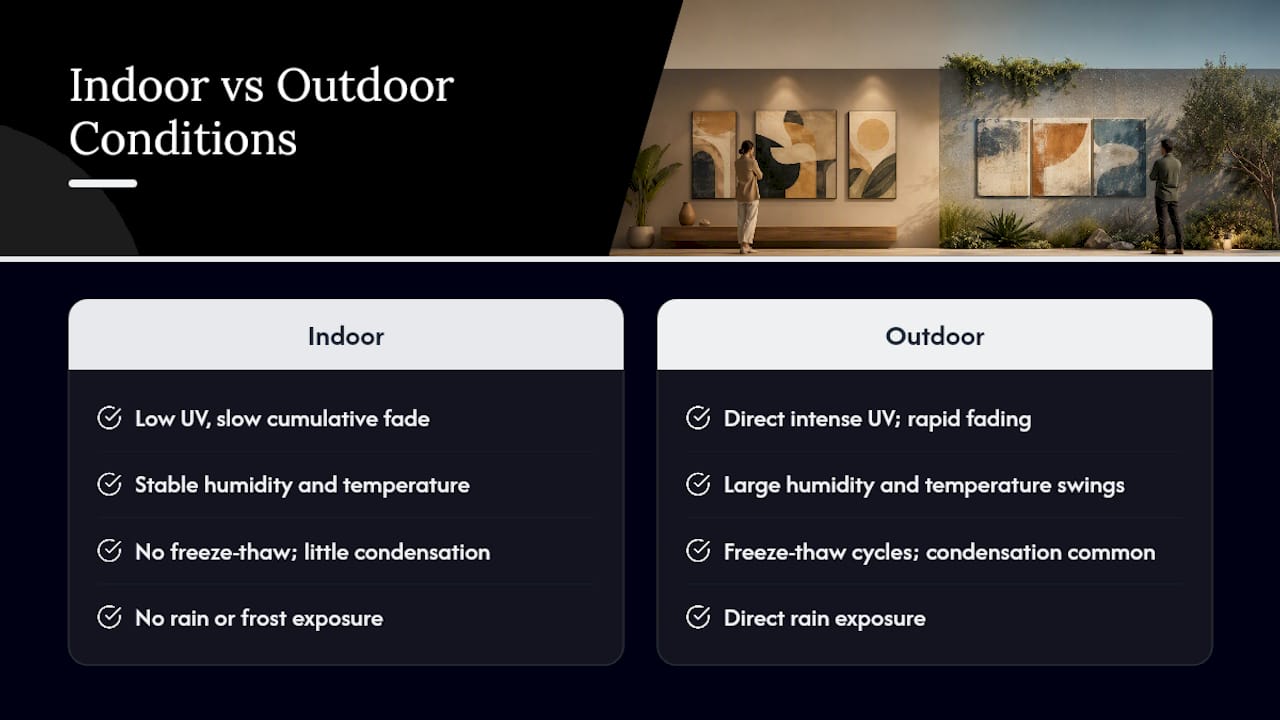
Indoor art lives in a controlled environment: stable temperature, humidity generally sits somewhere in a manageable range, and there’s no rain, frost or direct weathering to contend with. The main threat indoors is cumulative light exposure near a south-facing window, which slowly fades pigment over years rather than days.
Outdoor conditions are a different problem entirely. Direct UV exposure is constant and far more intense than anything a piece gets through glass, and it degrades pigment and varnish far faster. Humidity and temperature also swing dramatically outdoors, freeze-thaw cycles in winter, condensation and damp in autumn, baking heat in summer, and each of those cycles stresses paint film, support material and any adhesive or fixing in a way that a stable interior simply never does. Wind-driven rain adds a further mechanical wear factor that has no indoor equivalent.
This is precisely why an artwork built for a living room can’t simply be rehung outside and expected to survive. The pigments, primers, varnishes and supports that work beautifully in a hallway aren’t engineered to withstand direct rain or a hard frost, and a piece commissioned for an interior should stay there. It’s a genuinely separate design and materials problem, distinct enough that this guide focuses entirely on the indoor side of the equation.
What materials suit weatherproof outdoor pieces?
Because outdoor and indoor wall art face such different conditions, the material specification for anything hung outside is built around resistance rather than finish quality alone. Marine-grade or exterior-rated substrates, weatherproof coatings and UV-stable pigments are the baseline for anything expected to survive a full year of exposure, and fixings need to be corrosion-resistant rather than the standard picture hooks used indoors.
This is a genuinely different product category with its own supplier specialisms, sealants, exterior-grade panels, weatherproof mounting hardware, and it sits outside the scope of a bespoke indoor commission. Anyone weighing up an exterior piece is better served researching outdoor-specific specialists directly rather than adapting an interior recommendation, since the margin for error with weather exposure is much higher than with a piece hung in a dry, temperature-stable room.
How does installation differ for indoor and outdoor pieces?
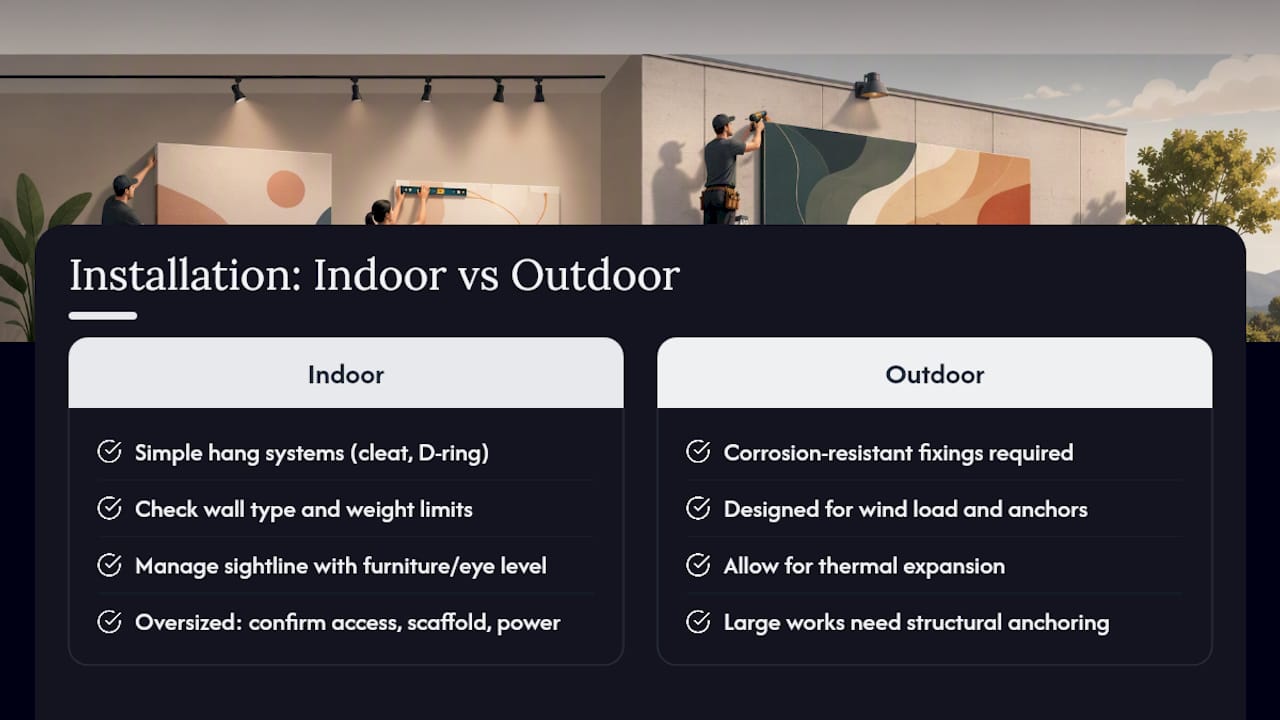
Indoor installation is comparatively straightforward. A gallery-wrapped canvas or a framed piece typically hangs on a French cleat, a security hook, or a simple D-ring and wire system, and the main considerations are wall type (plasterboard versus masonry), weight distribution for larger pieces, and getting the sightline right relative to furniture and eye level.
Outdoor installation carries a heavier engineering burden. Fixings need to resist corrosion and wind load, mounting has to account for thermal expansion in the material, and anything sizeable may need structural anchoring rather than a simple hook. For large indoor commissions, the same logic that governs any oversized fixing still applies: confirm access, any scaffold needs, and on-site power or hoisting arrangements with your installer before the piece arrives, since sorting that on the day is where installations go wrong. That’s a detail worth settling at the brief stage, alongside dimensions and lighting, rather than left to be discovered on delivery day.
What maintenance does each type of wall art need?
Indoor pieces are low-maintenance by comparison. A soft cloth, avoidance of direct spray cleaners, and periodic checks that fixings haven’t loosened is usually enough to keep a hand-painted canvas looking sharp for decades, particularly with a UV-filtering varnish in place near windows.
Outdoor pieces demand a completely different maintenance rhythm: regular inspection for coating wear, resealing on a schedule the material manufacturer specifies, and monitoring for the kind of pigment fade and surface degradation that constant UV and weather cycling inevitably cause. Durability expectations should be set accordingly. A well-made indoor commission, properly varnished and hung out of direct sun, can realistically last generations. An outdoor piece, however well specified, is fighting a harder battle from day one and will need more frequent attention to look right year after year.
How should style choices differ between indoor and outdoor art?
Indoor art can afford to be quieter and more layered. Fine detail, subtle tonal shifts and textured brushwork all read properly at close range, under controlled lighting, viewed for minutes at a time from a sofa or a boardroom chair. This is where the emotional register of a piece can genuinely carry a room, because the viewer has the time and the light to notice it.
Outdoor art generally needs to communicate at a glance and from a distance: bolder shapes, higher contrast, simpler compositions that still register clearly in shifting daylight or dusk. It’s a different design brief entirely, closer to signage or public art than to the considered, textured pieces suited to an interior. Anyone furnishing a garden or courtyard with decorative pieces at a smaller scale, rather than full exterior murals, might also look at novelty and gift-style outdoor decor as a lighter-touch option, though that’s a separate product category from the bespoke commissions this guide is built around.
Publisher perspective: how Frametheworld approaches bespoke indoor commissions
Commissions from this type of supplier are typically painted to order by real artists, never printed or AI-generated, with preview stages and unlimited revisions built in before shipping. That structure exists because the biggest risk in commissioning isn’t the painting itself, it’s a client discovering at delivery that the brief was misread. Clear technical briefs, trade support and installation planning close that gap before it opens.
Such suppliers typically get involved on large statement pieces and coordinated collections across multiple rooms or sites, work where consistency of tone matters as much as any single canvas. That’s a different job to buying a print off a wall, and it’s worth treating it that way from the first conversation.
— Lennard
Get a bespoke indoor commission started with Frametheworld
This type of supplier offers hand-painted commissions painted to order, with previews and unlimited revisions before shipping, sometimes backed by satisfaction guarantees and free returns. That combination matters most on exactly the projects this guide covers, an oversized feature wall, a matched palette, a coordinated set across a commercial site, where getting it wrong is expensive to fix after the fact.
Browse the Handpainted masterpieces collection to see the range on offer, or go straight to the Abstract or Landscape collections if you already know the style you’re after. For trade and commercial briefs, the next step is simple: put together the dimensions, lighting photos and swatches covered earlier in this guide, and send them across for a quote.
Sources
- How to Commission Original Artwork for Interior Design Projects | MadhavFineArt
- How Custom Wall Art Strengthens Commercial Branding
- Wall Art Solutions: Wall Printing vs Hand‑Painted Murals vs Custom Wallpaper – Caveman Murals
- Bespoke art for interior designers and architects | CommissionIt
FAQ
Is a bespoke commission always more expensive than ready-made art?
Not always, but expect a premium for the artist’s time and revision rounds. Larger commissions often work on a sliding per-square-inch scale, so cost per square inch tends to fall as overall size increases, and it’s worth requesting a project-specific quote rather than assuming a flat rate.
How much does a Frametheworld commission cost?
Frametheworld doesn’t publish fixed commission pricing, since bespoke pieces are quoted individually based on size, complexity and finish. Current prices for ready-made collections are listed directly on the Frametheworld site.
Can outdoor-style wall art be brought indoors?
Generally, no, weatherproof outdoor pieces use substrates, coatings and fixings built for a completely different set of stresses than an interior wall presents. Indoor commissions use materials optimised for stable temperature and controlled light rather than rain and UV resistance, so the two aren’t interchangeable.
How many revision rounds are normal for a bespoke painting?
Most studios build in a defined number of approval stages before a piece ships, and Frametheworld offers unlimited revisions as part of its commissioning process. Giving precise dimensions, lighting photos and swatches upfront is the fastest way to reduce how many rounds you actually need.
What’s the biggest mistake designers make when briefing a commission?
Leaving out precise dimensions, lighting conditions or material swatches is the most common cause of delays and cost increases, since it forces the artist to guess at details that should have been settled upfront. A front-loaded brief with a firm installation date keeps the whole project on schedule.


Leave a comment
This site is protected by hCaptcha and the hCaptcha Privacy Policy and Terms of Service apply.