
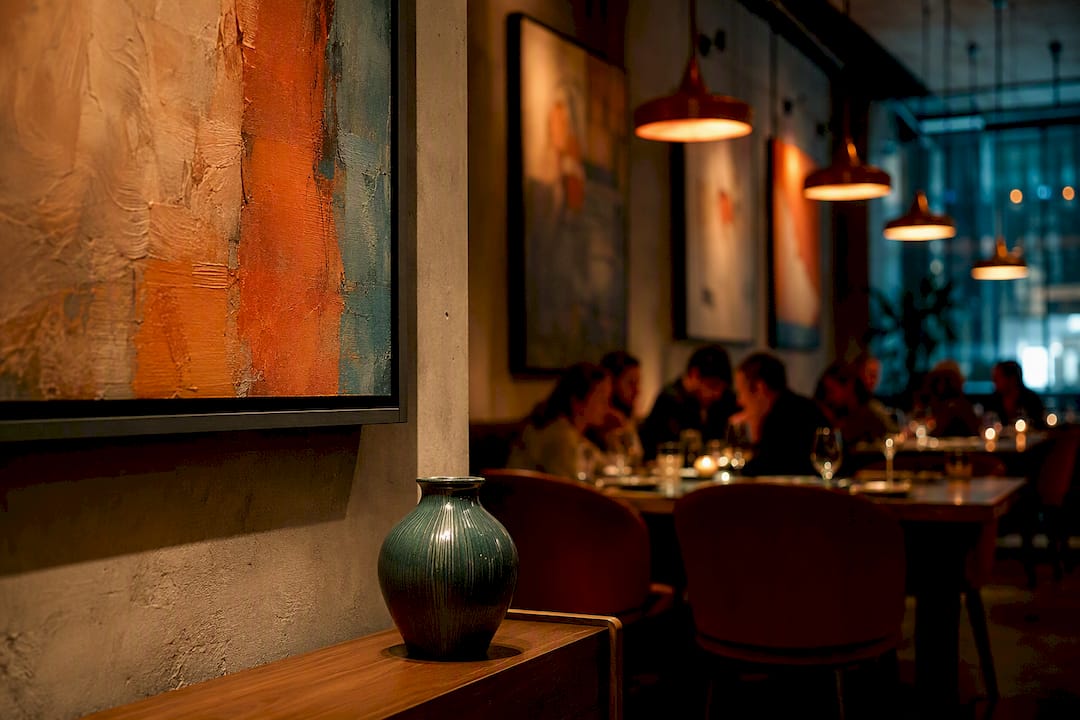
The highest-impact move is one oversized focal artwork opposite the entrance or behind the banquette, backed by a smaller rotating gallery elsewhere in the room. A single large piece reads as intentional and gives every table a photo-worthy backdrop, while the rotating gallery keeps regulars noticing something new without another big spend. Below, the practical ideas, placement rules, and commissioning steps to make it happen.
TL;DR:
- A single large focal artwork placed opposite the entrance or behind the banquette creates a photo-worthy backdrop and serves as the room’s primary visual anchor.
- Composition and placement rules recommend hanging art at seated eye level and reserving the strongest wall for the largest statement piece to maintain visual hierarchy.
- Durable materials like sealed acrylic, oil canvases, and powder-coated frames are essential to withstand heat, grease, and frequent cleaning in a restaurant setting.
- Warm white lighting around 2700K with angled spotlights enhances art impact and avoids glare, while dimmer circuits help adjust brightness during different service times.
- Working with local artists and utilizing rotation systems, like picture rails, provide cost-effective ways to keep wall decor fresh and aligned with the restaurant’s theme and target audience.
Table of Contents
- Restaurant wall art ideas: the top 10 to steal for your space
- Placement, scale and sightlines that actually work
- Materials, durability and maintenance for daily restaurant use
- Lighting and finishing touches that flatter the art, not the diner’s eyes
- Budget tactics, rotating shows and working with local artists
- Matching wall art to your restaurant’s theme and diners
- Legal aspects and permissions you can’t skip
- A designer’s honest take on what actually gets photographed
- Bring these ideas to life with Frametheworld
- Sources
- FAQ
Restaurant wall art ideas: the top 10 to steal for your space
Every idea below works because it does two jobs at once: it sets a mood and it gives diners something to photograph. Some suit a full commission; others you can pull off with a strong composition and a staple gun.
- Statement murals and illustrated feature walls. Best placed opposite the entrance or behind the host stand, where every arriving guest sees it first. A commissioned mural costs more than printed wallpaper but avoids the seam lines and colour drift that cheap prints show after a year of steam and grease.
- Gallery walls. Group framed prints in matching or complementary frames with even spacing. Careful spacing and framing consistency stop a gallery wall looking like clutter, and swapping two or three prints seasonally keeps it feeling current without a full rehang.
- Textured panels. Cork, fluted timber, or acoustic felt tiles double as decor and sound dampening, useful in a hard-floored dining room where conversation bounces.
- Bold paint and accent walls. One saturated colour on a single wall, usually the shortest one in the room, zones a bar area from the dining floor without a physical divider.
- Oversized mirrors. Hung opposite windows, they bounce daylight deeper into the room and make a narrow dining room feel wider. A slim brass or blackened-steel frame reads as intentional rather than borrowed from a bathroom.
- Living green walls or preserved foliage. Real installations need irrigation and a maintenance contract; preserved moss panels give the same biophilic softness with no watering and better acoustics.
- Custom neon or LED signage. A short phrase or logo mark works better than a paragraph. Get wiring specified by an electrician at fit-out stage, not bolted on afterwards.
- Sculptural or dimensional art. Metal, resin, or timber relief pieces need proper anchoring into studs or masonry, not just picture hooks, given the vibration from nearby foot traffic and door slams.
- Chalkboards and rotating concepts. Cheap, fast to update, and genuinely useful for seasonal menus and community shout-outs without repainting anything.
- Typography and branded canvases. A quote, menu excerpt, or logo rendered as art reinforces the concept at a glance, provided the type is large enough to read from three metres away.
Pro Tip: If budget only stretches to one thing, skip the gallery wall and commission the single large piece instead. One striking canvas at the right scale beats six mismatched prints, and it costs less to frame and hang.
Placement, scale and sightlines that actually work
Art has to earn its wall in a working dining room, not just look good in photos taken when the tables are empty.
- Hang the focal piece so its centre sits roughly at seated eye level, around 145 to 150cm from the floor, not standing eye level.
- Reserve your strongest wall, usually the one facing the entrance or the open kitchen, for the single largest statement piece.
- Scale the artwork to at least half the wall’s height for a genuine focal moment without crowding the ceiling line.
- Keep secondary walls for smaller, quieter pieces so the room has a hierarchy instead of competing focal points.
- Never hang art directly above a service pass, waiter station, or narrow aisle where staff will brush past it carrying trays.
Materials, durability and maintenance for daily restaurant use
Heat, steam, grease, and constant cleaning wipe out anything not built for commercial life.
- Choose sealed acrylic or oil canvases with a protective varnish rather than unsealed paper prints near kitchens or bars.
- Fit anti-glare or UV-filtering glazing on framed pieces close to windows or heat lamps.
- Pick washable, powder-coated or hardwood frames that survive a damp cloth wipe without warping.
- Check local fire regulations before hanging heavy fabric, foliage, or flammable materials near open flame cooking or candles.
- Bring in a professional installer for anything over roughly 1.5 metres wide or anything mounted on plasterboard, since a falling canvas near diners is a liability nobody wants.
Lighting and finishing touches that flatter the art, not the diner’s eyes
Good lighting is what separates a striking feature wall from a flat one.
- Use warm white LEDs, around 2700K, for a welcoming tone that flatters both skin and pigment.
- Angle spotlights at roughly 30 degrees to the wall to avoid glare bouncing back into seated diners’ eyes.
- Choose matte or anti-reflective glazing on framed prints positioned opposite windows or bright pendant lights.
- Keep neon or LED signage on a separate dimmer circuit so it can sit quietly in the background during lunch and glow properly at night.
Pro Tip: Test any new light fitting after dark with the room set for service, not during a daytime install. Warm bulbs that look fine at 2pm can throw an odd colour cast once the rest of the room dims for dinner.
Budget tactics, rotating shows and working with local artists
You do not need a five-figure commission to make a wall work.
- Choose one large printed or hand-painted piece over a wall of small ones; a single statement artwork typically costs less and reads stronger than assembling six or seven small frames.
- Set up a simple rotation: a picture rail or cleat system lets you swap art every one to three months without repatching walls.
- Approach local artists directly with a short consignment agreement covering commission split, insurance liability, and a hanging period, then promote the swap on social media as recommended in the Designer Trade Program - Interior Designers | One Day Doors & Closets.
- Use changeable, low-cost media, chalkboards, a digital photo frame, or a cork pinboard, for seasonal menus and community notices that don’t need a full redesign.
Matching wall art to your restaurant’s theme and diners
Wall art only works when it matches the story the rest of the room is already telling. A neon script sign might suit a late-night cocktail bar chasing a younger, social-media-driven crowd, but the same piece would look out of place in a quiet family trattoria built around comfort and tradition. Start by naming the concept in a sentence, rustic Italian, minimalist Scandinavian café, retro American diner, before choosing a single artwork.
Think about who actually sits at your tables. A fine-dining room courting an older, higher-spending clientele generally reads better with restrained, textured pieces in muted tones rather than loud pop-colour canvases. A brunch spot chasing a younger crowd can lean into bolder palettes and typography because that audience shares photos of the room as readily as the food. Choosing decor that reflects your brand and concept keeps every wall pulling in the same direction instead of feeling like decoration bought in three separate trips.
Cuisine matters too. A Japanese restaurant leaning into wabi sabi textures and natural materials tells a coherent story that a glossy pop-art print would undercut immediately. Match material, colour, and subject matter to what’s on the plate, not just what looked good in a showroom.
Legal aspects and permissions you can’t skip
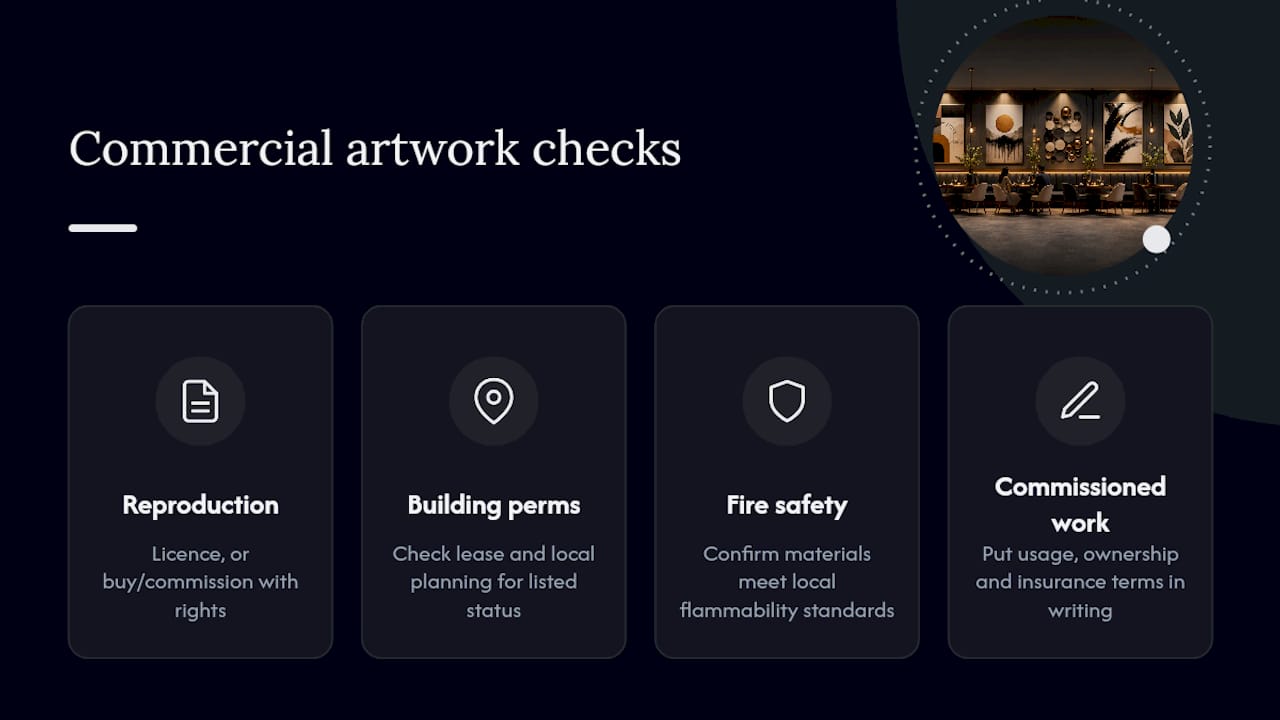
Displaying art in a commercial dining room is not the same as hanging it at home, and a few checks avoid expensive problems later. Copyright is the first hurdle: reproducing a photograph, illustration, or well-known artwork without a licence, even a print bought cheaply online, can expose the business to a claim from the rights holder. Commissioning original work or buying from a seller who holds clear reproduction rights sidesteps this entirely.
Commercial leases and listed or heritage buildings sometimes restrict what can be fixed to walls, particularly murals painted directly onto plaster or anything requiring structural drilling. Check the lease and, where the building has listed status, confirm with the local planning authority before any permanent installation. Fire safety rules also apply to materials, not just placement, so confirm that fabric, foliage, or timber panels near open kitchens or candles meet the flammability standards your local fire authority expects.
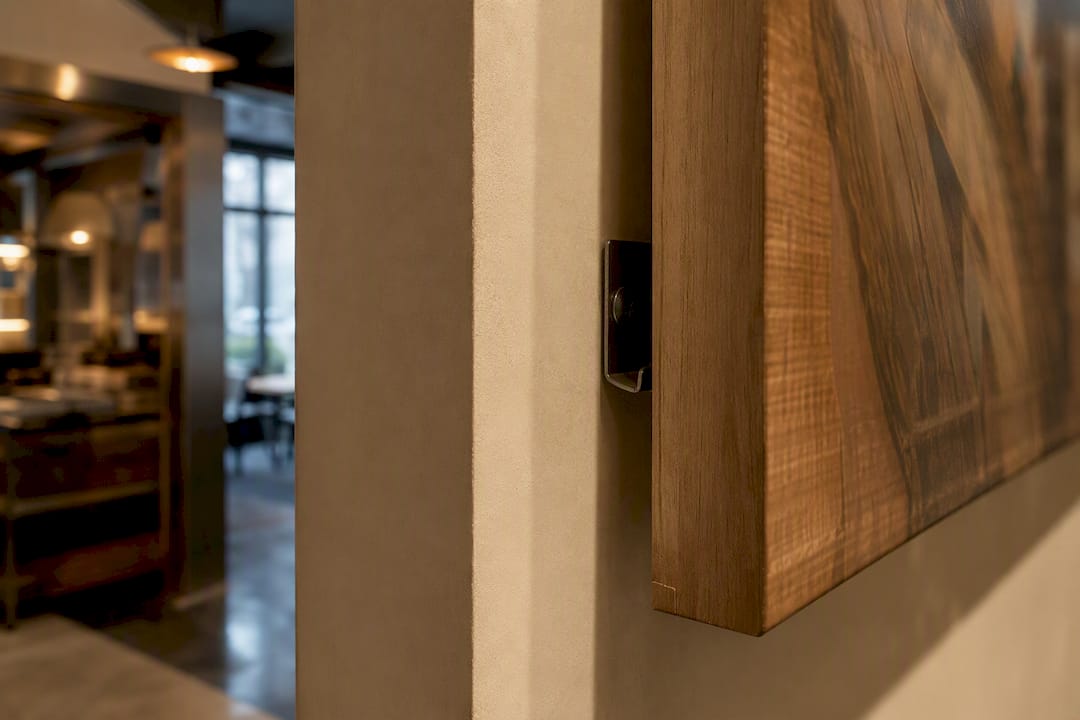
If you’re commissioning a mural or sculptural piece from an artist, put the usage rights in writing. Confirm who owns the final piece, whether the artist can reproduce the design elsewhere, and who carries insurance if it’s damaged during install.
A designer’s honest take on what actually gets photographed
The briefs that work best are never “surprise us.” They’re specific: a Neapolitan pizzeria wanted one wall that photographed well after dark, and a hand-painted, textured piece behind the pass outperformed the printed alternative they’d been quoted first. The lesson for any owner: pick one wall to get right before spreading budget thin across four.
— Lennard
Bring these ideas to life with Frametheworld
There are services available that help bridge the gap this article points at: knowing which wall art idea suits your restaurant is only half the job, getting it made to the right scale, in the right material, on your timeline, is the other half. Custom sizing means a mural-scale piece can be built to fit your actual wall rather than forcing your wall to fit a standard canvas size, and commission requests can address branding, colour matching, and durability finishes for commercial spaces.
For texture-led, wabi sabi-style interiors, the Wabi Sabi wall art collection offers hand-painted abstract pieces with the tactile depth that photographs well under warm lighting. For brighter, social-media-friendly dining rooms, the Pop Art collection delivers bold colour without needing a full mural budget.
Before requesting a quote, have three things ready: wall measurements (height and width), a material preference (canvas, textured, or framed print), and your target installation date. You can start a bespoke commission or browse ready-to-buy pieces from relevant providers to get a quote back within days.
Sources
- Restaurant wall decor ideas that instantly elevate your space
- Transform your space: The ultimate guide to bar wall decor in 2026
- 13+ eclectic cafe ideas to inspire your space
FAQ
What is trending in restaurant wall design right now?
Textured, hand-painted statement pieces and preserved-foliage green walls are leading, alongside neon or LED signage used sparingly rather than as the whole design.
What wall art should go in a restaurant dining room?
A single large focal piece opposite the entrance or behind banquette seating, scaled to roughly half the wall’s height, generally outperforms several small prints for both impact and cost.
How do I decorate a bare restaurant wall on a limited budget?
Choose one oversized print or commissioned canvas over multiple small frames, then add a rotating gallery of two or three prints you swap seasonally to keep the room feeling current.
What are the top restaurant design trends to watch for 2026?
Expect more preserved-foliage installations instead of live green walls, warmer 2700K lighting on feature art, and short-term local-artist collaborations replacing permanent, one-off murals in casual dining spaces.


Laat een reactie achter
Deze site wordt beschermd door hCaptcha en het privacybeleid en de servicevoorwaarden van hCaptcha zijn van toepassing.