
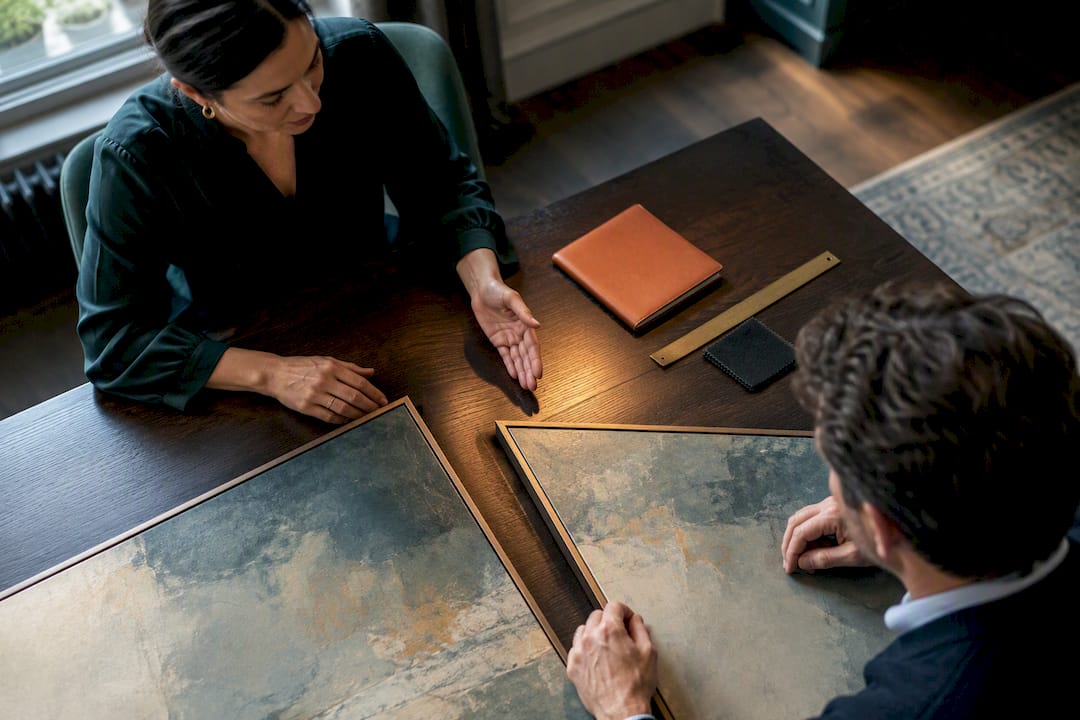
A diptych commission is a bespoke two-panel artwork sized and composed for your specific wall, palette, and room. To get an accurate quote, an artist needs your wall measurements, photos of the space, a short written brief and a budget range. Once you have those ready, contact an artist or platform and ask for a written quote before anything moves to production.
TL;DR:
- Clear communication of panel gap size and composition is crucial, as it influences how the artwork will be viewed and how elements align across panels.
- Expect additional costs for larger or more complex diptychs, with framing, shipping, and installation usually billed separately from the artist’s fee.
- Building in a schedule buffer is essential due to potential delays from drying times, revisions, framing, or seasonal scheduling issues for artists and framers.
- Confirm contracts explicitly cover scope, timeline, payment details, revision policies, ownership rights, and installation, keeping all correspondence documented.
- Ask how the artist manages panel consistency, their revision process, material specifics, and their policy if the finished work does not meet expectations.
Table of Contents
- Commissioning checklist: what to prepare before you contact an artist
- How to brief an artist for a diptych: composition, gap and orientation
- Timeline and cost: lead times, payment stages and what affects price
- Contracts, rights and consumer protection for bespoke artwork
- Framing, hanging and installation: decisions that shape scale and sightlines
- How Frametheworld manages diptych commissions
- Guidance on timeline variations and delays specific to diptych commissions
- Questions to ask an artist before commissioning a diptych
- Red flags to watch out for when commissioning diptych art
- A collector’s view on commissioning site-specific work
- How we can help: commission a bespoke diptych through Frametheworld
- Sources
- FAQ
Commissioning checklist: what to prepare before you contact an artist
Before you message any artist, gather the details that let them price and plan the work properly. A vague brief leads to vague quotes and slow back-and-forth, so put the groundwork in first.
- Take precise wall measurements: total width, height, and your preferred gap between the two panels.
- Photograph the hanging wall in natural light, including nearby furniture and light fittings.
- Decide on continuity: one continuous scene split across panels, a mirrored pair, or two complementary but distinct compositions.
- Note material and finish preferences, plus any framing or installation requirements.
- Set a budget band and a realistic deposit timeline, and flag any fixed deadline (a house move, an office opening).
- List delivery constraints such as narrow stairwells, lift access, or the need for professional installation.
Pro Tip: Photograph your wall at the time of day you’ll view the art most, so the artist can judge how natural light will hit the finished panels.
How to brief an artist for a diptych: composition, gap and orientation
The panel gap is the first decision, not the last. A narrow gap of a few centimetres reads as one continuous image with a visible seam, while a wider gap of 15 to 20 centimetres turns the two canvases into a deliberate pause, more like a conversation between them than a single split scene. According to the Wikipedia entry on diptychs, contemporary diptychs often use that gap as a compositional tool in its own right, shaping the rhythm between panels rather than just separating them. Decide the gap before finalising panel sizes, because it changes how a horizon line, a figure or a colour block should land on each canvas.
Once the gap is settled, build the rest of the brief around it.
- Share two or three reference images that show the mood, palette and focal point you want, and mark where you want the eye to land first.
- Confirm whether each panel needs to stand alone visually, in case you ever rehang them separately or move one to another room.
- State whether you want a true continuous composition (a single horizon crossing both canvases) or two panels that echo each other in colour and subject without lining up exactly.
- Ask the artist for photographs of finished pieces using the substrate and surface finish you’re considering, whether that’s a textured canvas, a smooth ground or a matte varnish.
Reference images matter more for a diptych than for a single canvas, because a palette or focal point has to travel convincingly across two surfaces without looking accidental. Tate’s definition of diptych notes that panels can be presented attached or simply adjoining, which is worth deciding early since it affects how the artist plans the composition’s edges.
Timeline and cost: lead times, payment stages and what affects price
A typical commission moves through five stages: brief and quote, a proposal or sketch for approval, production, drying or curing time for paint, and finally framing and delivery. Diptychs often add a small buffer at the production stage, since two canvases need to be checked against each other for balance before either is finished.
- Artist fee and materials (canvas, paint, ground) form the base cost, before framing or shipping.
- Framing, shipping and any on-site installation are usually quoted separately and vary with panel size.
- Expect a deposit before work starts, with the balance due on approval or before delivery. Always ask for an itemised quote rather than a single lump figure.
- Larger sizes, complex compositions and extra revision rounds all add time and cost, so budget some contingency into both.
Contracts, rights and consumer protection for bespoke artwork
A commission is both a purchase and a service, and UK law treats it that way. Under the Consumer Rights Act 2015, goods supplied by a trader must be fit for purpose, and any service, including the artist’s work in producing your piece, must be carried out with reasonable care and skill. That gives you a statutory basis for a remedy if the finished work falls well short of what was agreed.
A fair commission contract should be written in plain, prominent terms rather than buried in small print. Gov recommends putting significant terms in a clear summary so they’re easy to find and understand, which also reduces the chance of a dispute later.
Before you pay a deposit, confirm the contract covers:
- Scope: size, materials, composition and number of panels agreed.
- Timeline: production stages and an expected delivery window.
- Payment schedule: deposit amount, balance terms and what happens if either side needs to cancel.
- Revision policy: how many rounds of feedback are included before extra charges apply.
- Delivery and installation: who handles transport, and whether hanging is included.
- Ownership and copyright: confirming you own the physical piece and any limits on the artist reproducing the image.
Keep every email, quote and reference image on file. If a commission does go wrong, that record supports any claim you make under your consumer rights or through a dispute resolution service.
Framing, hanging and installation: decisions that shape scale and sightlines
Work out your total wall width before you finalise panel sizes, not after: add both panel widths, your chosen gap, and the width added by any frame rabbet or lip. Skipping this step is the most common reason a finished diptych ends up too large or too small for the wall.
- A floating frame leaves a shadow gap around each canvas, which reads as light and contemporary and suits abstract or landscape work.
- A boxed frame adds visual weight and a defined edge, useful when you want the diptych to anchor a room.
- Edge-painted canvases with no frame at all keep the piece minimal, letting the gap between panels do more of the compositional work.
- Large panels are heavy: check wall type and mounting hardware, and hire a professional installer for anything over a metre in width or height.
- Consider sightlines from seating and the light sources in the room, and decide now whether you want the option to rehang panels separately in future.
How Frametheworld manages diptych commissions
Commissions typically follow a straightforward process: you submit a brief, get matched with an artist, review previews before anything is finalised, and request revisions ahead of production and delivery. The platform states that every piece is hand-painted to order, never a mass-produced print or AI-generated image.
For buyers preparing a brief, Frametheworld’s site-specific artwork guide and its multi-panel art overview both walk through dimension planning and composition choices in more depth, and its ready-made contract template gives you a starting point for the paperwork above.
Guidance on timeline variations and delays specific to diptych commissions
Two panels rarely finish on exactly the same day. Paint drying times, framing schedules and quality checks that compare both canvases side by side all add small delays that a single-canvas commission doesn’t face, so build slack into any deadline you give an artist.
The most common causes of delay are late approval of the proposal sketch, extra revision rounds once you see the panels together, and framing lead times when the two frames need to match precisely in tone and profile. Custom framing, in particular, often runs on its own schedule once the painted panels are finished, and a mismatch discovered at that stage can add another week or two while it’s corrected.
Seasonal demand matters too. Artists and framers both tend to book up ahead of the winter holidays and around major house-move periods in spring, so a commission started in those windows may run longer than one started in a quieter month. If you have a fixed deadline, tell the artist at the brief stage rather than partway through production, and ask them to flag immediately if the schedule slips rather than waiting until the delivery date arrives.
Building in a buffer of a few extra weeks beyond the quoted delivery date is sensible for any diptych, particularly one involving framing, shipping to a different address, or installation by a third party.

Questions to ask an artist before commissioning a diptych
Before you commit a deposit, a short list of direct questions will tell you more about an artist’s process than their portfolio alone.
Ask how they plan to handle the relationship between the two panels: do they paint both simultaneously, or complete one before starting the second? Simultaneous work tends to keep colour and tone more consistent across the pair. Ask exactly how many revision rounds are included and what happens, in cost or time, if you need more.
Confirm the materials they intend to use, including canvas weight, paint type and any varnish or sealant, and ask for photographs of a comparable finished piece rather than relying on a general portfolio shot. Ask how they’ll share progress: some artists send photos at set milestones, others only reveal the finished proposal.
Finally, ask what happens if you’re not satisfied with the finished piece: is there a satisfaction guarantee, a return policy, or only the option to request paid alterations? The answer tells you a lot about how much risk you’re carrying as the buyer.

Red flags to watch out for when commissioning diptych art
Some warning signs are worth treating as deal-breakers rather than minor inconveniences.
Walk away from an artist or platform that won’t put pricing in writing before you pay a deposit, or that gives you a single lump figure with no breakdown of materials, framing and shipping. A lack of any written brief or contract is a bigger risk than it might seem: without one, you have little to point to if the finished work doesn’t match what was discussed.
Be cautious of vague answers about materials, unwillingness to show comparable finished work, or reluctance to commit to a delivery window in writing. Pressure to pay the full amount upfront, rather than a deposit with a balance due later, removes your leverage if something goes wrong partway through. And if an artist can’t or won’t clarify their revision policy before you’ve paid anything, assume there isn’t one, and negotiate that in writing before you proceed.
A collector’s view on commissioning site-specific work
Commissioning makes sense the moment you have a wall that off-the-shelf art can’t quite fit. My one practical habit: approve mock-ups in situ, using a life-scale printout or a projected image taped to the actual wall, before any paint goes on canvas. It catches sizing mistakes that a screen never will.
— Lennard
How we can help: commission a bespoke diptych through Frametheworld
The commissioning service takes the guesswork out of the checklist above: you submit your measurements and brief, get matched with an artist, and review a preview before production starts. Every piece is hand-painted to order.
- Browse handpainted masterpieces for style references before writing your brief.
- Explore the Abstract and Landscape collections if you’re still deciding on subject matter.
- Request a written quote once your measurements, gap and budget are set.
If you’re ready to move forward, start at Frametheworld and submit your brief for a bespoke diptych quote.
Sources
For contract wording and definitions used above, see the Consumer Rights Act 2015, GOV.UK’s fair contract guidance, and the Cambridge Dictionary entry on diptych.
FAQ
How much does an art commission usually cost?
Pricing depends on size, materials, framing and the artist’s own rates, and most artists quote per commission rather than at a fixed rate. Ask for an itemised quote covering the artist fee, materials, framing and shipping separately, so you can see exactly what drives the total.
What is the 70/30 rule in art?
Definitions vary by source and context, and there’s no single agreed rule that applies universally to diptych commissioning or composition. If an artist references it, ask them to explain how they’re applying it to your specific brief.
What does diptych mean in art?
A diptych is an artwork made of two related panels intended to be displayed together, according to both Tate and the Cambridge Dictionary. Historically the term described hinged, folding panels, though modern diptychs are usually two separate canvases hung with a gap between them.
How much does an art commission cost in the Philippines?
Commission pricing in the Philippines follows local artist rates and market conditions, which differ from pricing elsewhere, so it isn’t covered by the guidance in this article. Contact artists or platforms operating in that market directly for a quote based on your brief.


Laat een reactie achter
Deze site wordt beschermd door hCaptcha en het privacybeleid en de servicevoorwaarden van hCaptcha zijn van toepassing.