

You can safely remove dust and light grime from a canvas yourself using a soft dry cloth or a barely damp microfibre, testing a small area first. Anything beyond that (stains, discolouration, flaking paint) is a job for a trained eye. The Institute of Conservation and framing specialists both make the same point: less handling, done carefully, protects a painting far better than an ambitious clean.
TL;DR:
- Routine dusting with a soft microfibre cloth or natural-hair brush prevents grime buildup without risking paint damage, especially if flakes or cracking are present.
- Use a barely damp cloth with distilled water only after testing carefully on an inconspicuous area, and never rub or use aggressive cleaning tools like vacuums or compressed air.
- Avoid household cleaners, solvents, or aerosol sprays, as these can cause irreversible damage to the paint or varnish when used improperly.
- Protect paintings by keeping them away from direct sunlight, maintaining stable humidity, and using glazing with spacers and backing boards to prevent long-term deterioration.
- Call a conservator immediately if you notice flaking, lifting paint, water stains, or structural tears rather than attempting DIY fixes that could make damage worse.
Table of Contents
- How do you clean canvas artwork safely at home?
- Can you use a damp cloth on canvas paintings?
- What should you never use to clean a canvas painting?
- How should you display and store canvas artwork to prevent damage?
- When should you call a professional conservator?
- Frametheworld’s take on protecting canvas artwork long term
- Why prevention beats restoration every time
- Sources
- FAQ
How do you clean canvas artwork safely at home?
Routine dusting is the one cleaning task nearly every canvas needs, and it’s the safest thing you can do without training. A soft microfibre cloth or a soft natural-hair artist’s brush lifts surface dust without dragging grit across the paint film. Skip anything stiff bristled or textured. Grip the cloth loosely and work in short, light strokes, moving from the top of the canvas downward so dust falls away rather than getting rubbed back in. Keep the cloth clean by shaking it out regularly. A dusty cloth just redistributes grime rather than removing it.
While you dust, look closely at the surface. Micro flaking, hairline cracking, or paint that feels tacky rather than firm are all signs the work needs a conservator’s assessment before you touch it again. The National Trust recommends exactly this light touch and explicitly warns against vacuuming, feather dusters, or compressed air, since suction and airflow can lift loose paint flakes clean off the surface, and feather dusters can catch and snag on raised texture.
- Soft microfibre cloth or soft natural-hair brush, dry, for weekly or monthly dusting
- Light, short strokes, top to bottom, never circular or scrubbing
- Stop and inspect if you see flaking, cracking, or tacky patches
- Never use a vacuum, feather duster, or compressed air on a canvas
Pro Tip: Dust regularly before grime builds up. Routine dusting prevents the need for more intensive cleaning, which is the whole point of preventive care.
Can you use a damp cloth on canvas paintings?
A barely damp cloth works for light grime and surface smudges, but only once you’ve confirmed the paint layer can tolerate moisture. Acrylic paints are more water sensitive than oils. Their emulsion binder can soften or leach surfactants when wet, so treat any acrylic canvas with more caution than an oil painting. The Canadian Conservation Institute warns that aqueous cleaning without testing can weaken pigment bonds and cause blanching, regardless of medium.
Prepare properly before you start. Use distilled or de-ionised water rather than tap water, which carries minerals that can leave residue. Wring your microfibre cloth until it feels barely damp, not wet. Keep several clean cloths or cotton swabs on hand so you avoid reusing dirty ones that would redeposit grime.
- Test first. Dab a small, inconspicuous corner and wait a minute to check for any colour transfer or texture change.
- Work edge to centre. Swab gently from the outer edge inward, in small sections, rather than dragging across the whole canvas.
- Blot, don’t rub. Press lightly and lift. Rubbing drives moisture and grime into the weave instead of removing it.
- Change cloths often. A grubby cloth just smears dirt back onto clean areas.
Conservators use a more rigorous version of this same idea, called swab-roll testing, where they check solvent strength on tiny cotton rolls under magnification before committing to a larger area. That level of precision is exactly why the CCI treats it as a specialist task rather than a household one.
Stop immediately if you notice blanching (a pale, cloudy patch), any lifting of the paint surface, or a shift in colour. Those are signs the paint or varnish is reacting badly to moisture, and continuing will only make the damage worse.
What should you never use to clean a canvas painting?
Certain products and tools cause damage that’s often irreversible, and they show up in cleaning advice online far more often than they should. Avoid every one of the following on a canvas painting:
- Household sprays, glass cleaners, or all-purpose cleaners of any kind
- Acetone, white spirit, or any solvent-based wipe
- Vacuum attachments, even on the lowest setting
- Compressed air canisters
- Furniture polish or aerosol sprays of any description
Household cleaners are formulated for glass, wood, or plastic, not for paint film sitting on a flexible canvas weave. They strip varnish, soften paint, and leave chemical residues that attract more dirt over time. Solvents like acetone can dissolve varnish and pigment binders in seconds, with no way to reverse it once it’s happened.
If you’ve already used one of these by accident, stop immediately. Do not rub or try to “fix” the area yourself. Isolate the affected section from further contact and photograph it before contacting a paintings conservator for an assessment.
How should you display and store canvas artwork to prevent damage?
Where and how you display a canvas does more to protect it long term than any cleaning routine ever will. Direct sunlight fades pigments and accelerates varnish degradation, so keep canvases away from south-facing windows and well clear of kitchens, where airborne grease settles invisibly onto the surface over months. A stable environment matters too. Aim for relative humidity around 40 to 60 percent where practical, and avoid hanging paintings above radiators or in bathrooms where humidity swings widely.
Framing choices make a real difference here. Glazing (glass or acrylic) fitted with a small spacer, roughly half a centimetre, keeps the surface from touching the glass while still filtering dust and UV light. A backing board behind the canvas blocks moisture and knocks from the rear, creating what conservators call a stable microenvironment inside the frame.
- Keep canvases out of direct sun and away from cooking areas
- Maintain steady humidity rather than a damp or bone dry room
- Choose glazing with a spacer, never glass or acrylic pressed flat against the paint
- Wear clean gloves when handling unframed canvases, and never write on the reverse
- Store spare canvases vertically, never stacked flat with weight on the surface
Pro Tip: Good glazing and a backing board often cost less over ten years than a single conservator’s cleaning bill. Prevention is genuinely the cheaper option here.
When should you call a professional conservator?
Certain signs mean you should stop cleaning entirely and call in a specialist. Flaking or lifting paint, a surface that feels soft or tacky rather than firm, a large area that’s been wetted, or any structural tear in the canvas all fall well outside safe home maintenance.
- For water damage, act fast but carefully. Blot excess water gently with clean blotting paper rather than rubbing. Lay the canvas flat, face up if the paint side is affected, and use a weighted board technique with blotters changed on a schedule to draw out moisture evenly, as the CCI’s emergency guidance sets out. Uncontrolled drying can cause more warping and cockling than the water itself.
- For tears or flaking, avoid touching the affected area at all and contact a conservator promptly for a condition assessment.
A qualified paintings conservator will test before treating, often on a tiny hidden area, because many interventions are irreversible once started. That caution is the whole discipline in a nutshell.
Frametheworld’s take on protecting canvas artwork long term
Frametheworld builds bespoke framing, glazing, and backing board solutions specifically because prevention beats cleaning every time. Our UV-protection guidance and framing resources exist to help owners set up a canvas so it rarely needs anything beyond a light dust.
If a piece is large, valuable, or painted in a particularly sensitive medium, professional framing may be worth considering before problems start, not after.
- Choose glazing with UV filtering for canvases in bright rooms
- Add a backing board for any canvas that travels or hangs in a variable climate
- Consider bespoke framing for oversized or high-value works rather than off-the-shelf options
- Browse hand-painted collections to see framing paired with commissioned pieces from the outset
Why prevention beats restoration every time
The conventional advice on canvas care tends to focus almost entirely on cleaning techniques, and that’s the wrong emphasis. The genuinely useful lesson from conservation guidance isn’t a better cleaning method. It’s that most paintings never need serious cleaning if they’re framed and displayed sensibly from day one.
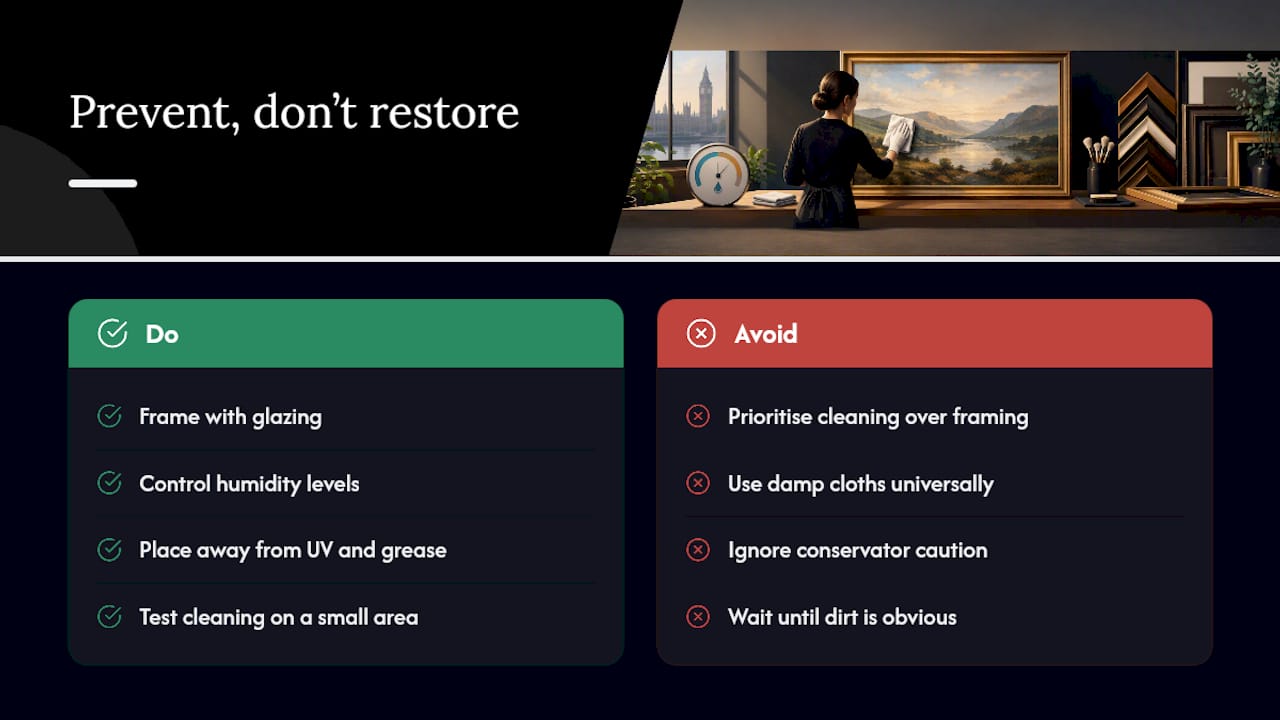
What gets underestimated is how much damage happens gradually and invisibly, through UV exposure, humidity swings, and grease from a nearby kitchen, long before anyone notices grime on the surface. By the time a canvas looks dirty enough to clean, some of that damage is already baked in. Spend your effort on glazing, placement, and humidity control first. Dusting is maintenance. Framing is prevention.
The other place conventional advice falls short is treating “damp cloth cleaning” as a universal green light. It isn’t. Acrylic paintings behave differently to oils, and modern mixed media can react in ways that even careful owners won’t anticipate. Test small, stop at the first odd sign, and accept that a conservator’s caution isn’t excessive. It’s the correct response to genuinely irreversible risk.
— Lennard
Sources
- Institute of Conservation (ICON) – Caring for your collections
- Canadian Conservation Institute (CCI) – Cleaning paintings: precautions
- National Trust – How to care for your precious objects
FAQ
How do you make canvas look new again?
You generally can’t, and trying to is the wrong goal. Conservators aim for stability and gentle cleaning rather than a “like-new” finish, since aggressive restoration risks permanent damage, according to ICON. Regular dusting and good framing keep a canvas looking its best without chasing an unrealistic result.
What is the best cleaner for canvas paintings?
For routine care, a dry soft microfibre cloth or soft natural-hair brush is the safest option, and a barely damp cloth with distilled water handles light grime on tolerant surfaces. Avoid any commercial cleaner, spray, or solvent, since these can strip varnish or weaken the paint layer, as the CCI notes.
What do conservators use to clean paintings?
Conservators test solvent strength on small cotton swab rolls under magnification before treating any larger area, adjusting their approach painting by painting. This precision, described in CCI guidance, is why professional cleaning isn’t something to replicate at home.
Does water damage canvas?
Yes, water can cause warping, cockling, and paint lifting, particularly if it dries unevenly or sits for a long time. Emergency care means controlled drying with blotting paper and a weighted board rather than leaving it to dry naturally, following the CCI’s emergency protocol. Contact a conservator as soon as possible after any significant wetting.


Laat een reactie achter
Deze site wordt beschermd door hCaptcha en het privacybeleid en de servicevoorwaarden van hCaptcha zijn van toepassing.